
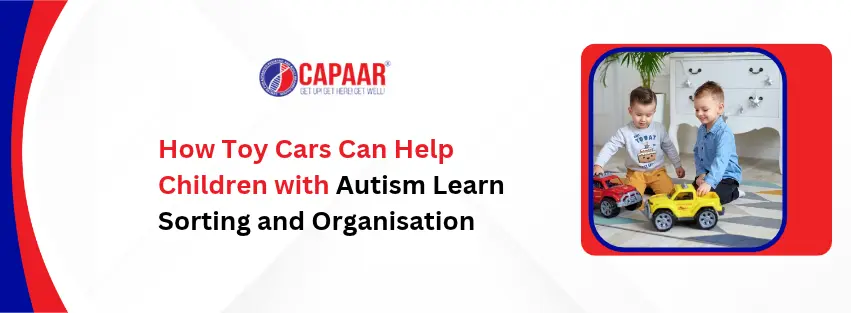
Children with autism often benefit from hands-on activities that make learning fun, visual, and easier to understand. Toy cars are a simple yet effective tool for encouraging sorting, organisation, and early thinking skills. By grouping cars according to colour, size, shape, or type, children can practise important everyday skills through play. Parents looking for guidance from an Autism Centre in Bangalore can also explore play-based learning activities that support each child’s individual needs.
Sorting helps children recognise similarities and differences between objects. Toy cars provide an enjoyable way to practise these skills without making learning feel like a formal lesson. Parents can begin by asking their child to place all red cars in one group and blue cars in another. Later, children can sort cars by size, shape, or design. These activities help develop visual discrimination, attention, and categorisation skills.
Start with two simple categories and gradually introduce more as the child becomes comfortable. Use clear instructions and demonstrate the activity when needed.
Organisation involves knowing where things belong and following a simple system. Toy cars can help children develop these habits in a familiar setting. For example, parents can introduce separate boxes for different colours or sizes of cars. After playing, children can return each car to its designated box. Labels, colour-coded containers, and picture cards can make the process easier to understand.
Repeated practice encourages children to follow routines, keep play areas organised, and become more independent over time. Remember to offer gentle reminders and celebrate small achievements.
Toy car activities can also encourage children to listen, focus, and follow simple instructions. Parents might say, “Find the yellow car,” “Put the big cars together,” or “Place three cars in the box.”
These short tasks allow children to practise listening and completing one step at a time. As their confidence grows, parents can introduce two-step instructions, such as finding a green car and placing it in a particular container. Activities should match the child’s current abilities and interests. Short, enjoyable sessions are often more effective than lengthy tasks.
Playing with toy cars creates opportunities for communication. Children can learn words such as red, blue, big, small, same, and different. Parents can describe what the child is doing, ask simple questions, and model useful vocabulary. Children who communicate using gestures, picture cards, or augmentative and alternative communication (AAC) can participate too. Speaking is not a requirement for successful learning.
Families seeking professional support from an Autism Centre in Bangalore can ask about individualised strategies that encourage communication, play, and everyday independence.
Conclusion
Toy cars offer a playful way to teach children with autism sorting, organisation, attention, and early communication skills. Simple activities such as grouping cars by colour, using labelled storage boxes, and following short instructions can make everyday learning meaningful. Every child develops at their own pace, so patience, encouragement, and flexibility are essential. An Autism Centre in Bangalore can help families identify suitable play-based strategies based on their child’s strengths, interests, and support needs.
l developmental journey.
FAQ’s
Yes. Sorting toy cars by colour, size, or type can help children practise categorisation, visual discrimination, and early problem-solving skills.
Activities can begin when a child shows interest and is developmentally ready to participate. Start with simple choices and adapt the task to the child’s abilities.
Use labelled boxes, colour-coded containers, or picture labels. Demonstrate where each car belongs and encourage your child to put the toys away after play.
Lining up cars can be an enjoyable and meaningful form of play. Join your child’s activity and gently introduce sorting or grouping opportunities without forcing a change.
Begin with a few minutes and follow your child’s interest and attention. End the activity if the child becomes frustrated or needs a break.